

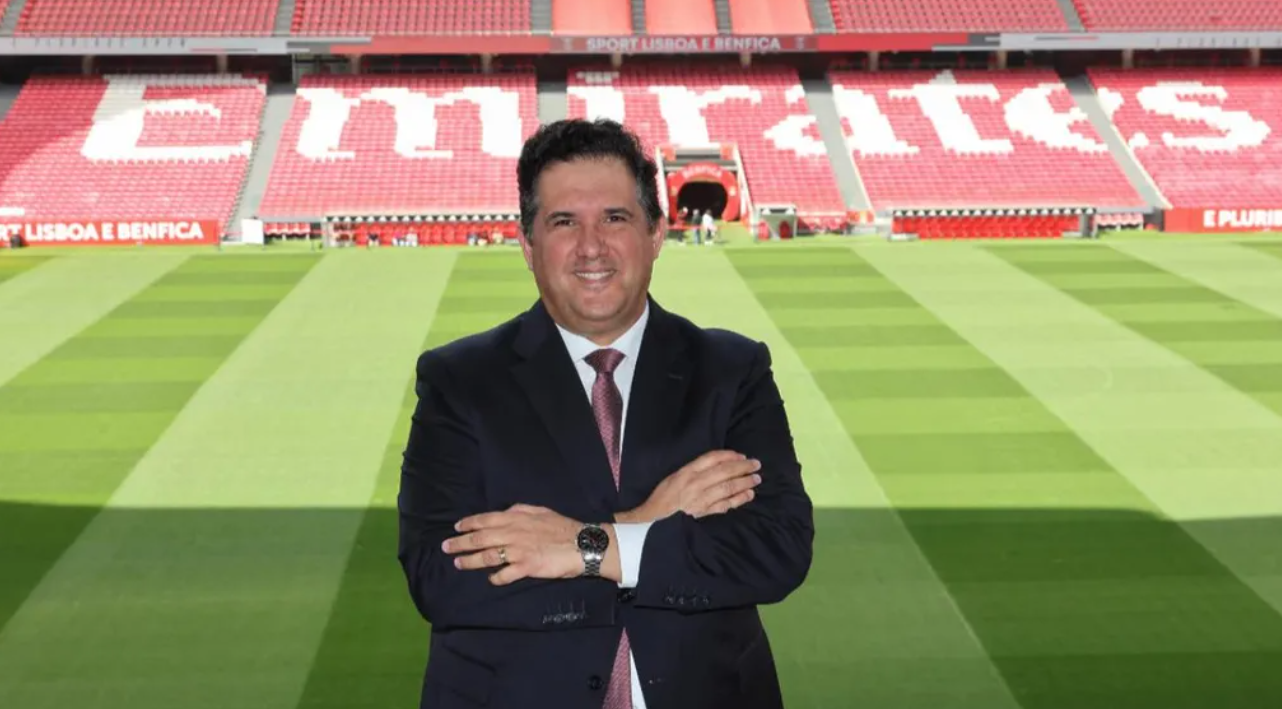
Nuno Catarino, CFO of Benfica, laments the lack of groundwork done in the last five years and assures that the accounts revealed this Friday show that the club does not need this centralization.
Benfica’s CFO, Nuno Catarino, highlighted the €29 million profit in the first half of the 2025/26 financial year . In an interview with BTV, the Benfica executive stressed that it is a “very good” result and also mentioned the “unparalleled numbers” in revenue from new members and merchandising. Furthermore, he asserted that Benfica does not need centralized financial control.
The result of 29 million euros is obviously quite good. But I would like to highlight this part: we are talking about a 6 percent increase in the club’s recurring operating profit, which rises to 6.7 million euros, which I think – if we want to see the club without football, because we can always see football separately, looking at the SAD (Sporting Limited Company) = is perhaps the way in which we can have more granularity and a better understanding of what we are talking about here, said Nuno Catarino, in an interview with BTV. The organization of Benfica’s elections, as revealed in the report, had a total cost of 3.2 million euros, despite the initial budget of 550,000 euros. Nuno Catarino justified this increase with the opposition of some lists to electronic voting and the need for a second round.
There was a time when cost estimates were already at 4/5 million euros, but we managed to negotiate a lot at the time and closed at 3.2 million euros.”
Benfica’s CFO also addressed the negotiations for the centralization of television rights, specifically the productive meetings with various parliamentary groups in the Assembly of the Republic. Nuno Catarino assured that Benfica does not need centralization and stressed that no one will be satisfied with the final result in 2028.
“We explained that there was a decree-law that was created in a context that is no longer the same as today’s. The way the product is consumed and viewed is very different from what it was 10 years ago, and the decree from five years ago was based on what was done 10 years ago. Therefore, there is almost a disconnect from reality in the decree-law. And the decree-law, in practice, brings the format of Big Bang centralization: there’s a wonderful day when a new world appears. I think we’ve all realized that’s not what’s going to happen. And it obviously had a premise: to return 300 million euros, which would accommodate some growth for Benfica, greater growth for smaller clubs, some growth for the other two big clubs, for Sporting Braga, for all the teams. In other words, we were in a wonderland five years ago. I think everyone has already realized that this is not going to happen.
Benfica, it should be recalled, suspended its participation in the Centralization League in July of last year , and Nuno Catarino stressed that the Eagles made “concrete proposals.” The director also highlighted the club’s new contract with NOS.
“The first thing is: Benfica doesn’t need centralization to enhance the value of the product it sells. Benfica doesn’t need it. Just now, it went to the market under conditions that weren’t easy to begin with, only being able to sell a product for two years, when everyone else is looking for a five-year or ten-year product. It’s unheard of to go to the market to sell a sports product for two years, because there isn’t enough time for an operator who wants to innovate to make sufficient innovations to the product to achieve results. Despite this, we had a much better result than anyone in the industry expected, and many people had to eat their words from the past, because Benfica’s result was superior to what it had before, in a context that I’ve already defined as adverse, with which we all agree.
Benfica’s financial director stressed that the club’s management is not unaware and listens to the concerns of others,” hence presenting solutions.
We understand that, due to the same problem Benfica had = but Benfica managed to negotiate, others can’t… = there are clubs that don’t even have contracts anymore. They are asking, they are with their hands outstretched asking for much lower contracts to fill the gap until 2028. And, when 2028 arrives, they still don’t have a solution. What we have been saying is that two things make sense in centralization: a postponement of what has been done to allow time to do the homework, which hasn’t been done so far, and to rethink the model a little, but, above all for these clubs, that they make a voluntary centralization, that is, that they join together, and that makes perfect sense. 10, 20, 30 can join together, whoever wants to join. They package their product, try to sell their product on the market, and here we have a voluntary centralization of those who need this format as it is here. If I think we could do much better as an industry and value the product differently, I think so, but for that, we needed to have done fieldwork that hasn’t been done in the last five years. I’ve been at Benfica for a year and a half, but I’ve seen what we said before. We’ve always said the same thing: there’s work that needs to be done to value the product. You don’t value a product where our players get ready in locker rooms… people don’t see it, but the conditions aren’t right. Where we film in stands that are off-limits for safety reasons, stands that don’t exist… I won’t even elaborate… A product where we haven’t even been able to invest in semi-automatic offside technology, which means we sometimes wait three minutes for an offside decision to be made. We’re talking about investments, but we’re not talking about that much money. And Benfica has been making investments. In fact, Benfica TV is here, and we were recently discussing some investments we’re going to make in Benfica TV.” “We’ve been investing in Benfica TV for 15 years. We feel that Benfica invests, tries to improve the product, sells the product, even in a different way than others. And it’s not just a matter of distribution on Benfica TV; the way we sell advertising is also different. Others sold advertising to someone to sell for them, and we sell directly. There are several areas where we feel we make an effort to go further. That’s why we say we don’t need to, to market this better, to extract more value from the product. Other clubs would benefit from having scale, I have no doubt about that. So, let’s create this model, of variable geometry, where each one does what’s best for them. Some of them should join forces; we think that makes perfect sense. This process should have started sooner.
Don’t copy and paste from other markets. Especially markets that are already doing poorly.”
Nuno Catarino acknowledged that the talks with the parties were very important,” but warned that it is not possible to “copy and paste from other markets.
“There’s one thing we’ve been saying: the way things are today, nobody will like the final result in 2028. If we don’t change the way things are being done… There are some exceptions, some SADs (Sporting Limited Companies) that have very specific contexts, where in fact today they receive nothing, and if they start receiving something, they will naturally be happy. (…) Benfica has this social mission, this doesn’t exist anywhere else in the world, and we come back to the issue of: don’t copy-paste us from other markets. Especially other markets that are already doing badly… and just look at the Netherlands, which is always the example given: we are talking about an economy that is almost the size of Spain’s, and it already has difficulties competing with Portugal. Because we, despite everything, with this art, sometimes ingenuity, of each one trying to do their best for themselves and making the model work with some tension, have managed to grow the product in Portugal. As I said, if we don’t change the situation as it is, nobody will like the final result, he concluded.