

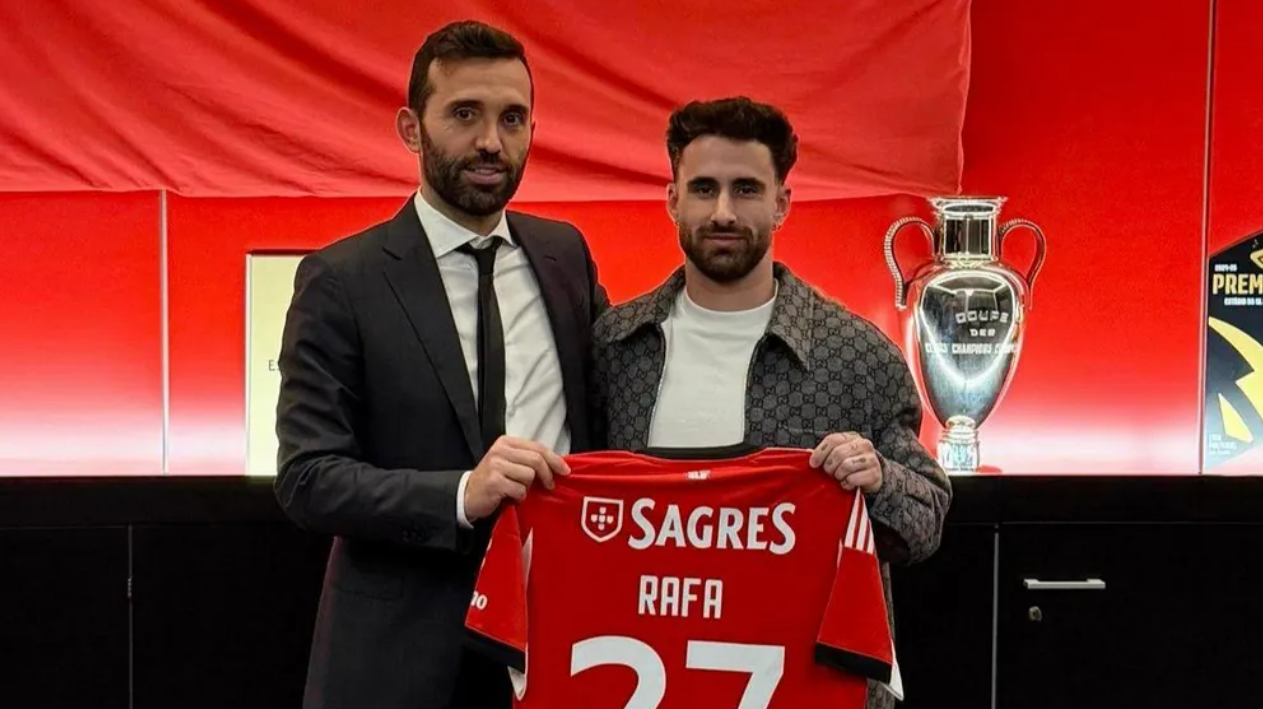
MF interview with João Araújo, CEO of Onsoccer and Rafa Silva’s manager (PART I)
Signed by Besiktas in the summer of 2024, Rafa Silva ended a relatively short but impactful spell at the Turkish club in January. Impactful for the numbers (23 goals, 15 assists, and 65 games), but also for the turbulent way in which the relationship ended.
The striker and the Turkish club entered into a power struggle at the end of October, which reached a boiling point in mid=November, after much accumulated discontent with the club’s sporting direction led Rafa to say “enough” and want to leave the club more than a year and a half before the end of the three-year contract he had signed.
Until the 32=year=old player’s return to Benfica, which took place on January 22nd, much was said and written about this saga, both by Besiktas officials and the Turkish press. João Araújo, Rafa’s agent, issued only one statement, at the height of the crisis and in response to a press conference held by the president and coach of Besiktas.
Until now.
In an interview with Maisfutebol , the CEO of On=soccer, the company that has managed the footballer since he turned professional a decade and a half ago at Feirense, tells all about the “soap opera” that marked the autumn/winter, but whose script had already begun to be written a long time ago, with increasingly obvious signs of managerial and sporting instability.
In this conversation, João Araújo reveals all the reasons that led Rafa to decide not to wear the Besiktas jersey again: “They wanted him to sign a document stating that to return to playing football he had to pay 15 million euros.”
He clarifies some controversies that have marked the last few months and talks about his return to Benfica. Which, he assures, only began to take shape when the clubs started negotiating back in January.
And now? Under normal circumstances, Rafa will end his career at Benfica.
READ PART II OF THE INTERVIEW WITH JOÃO ARAÚJO: The way some companies approach player management is aggressive
Maisfutebol = When he was presented at Besiktas in the summer of 2024, Rafa said the following: I won’t regret moving here. When did he first tell you that he was unhappy and didn’t want to fulfill the three-year contract he had signed?
João Araújo = He started to realize it over time. Then, in November or December of 2024, the president left, and within six months all the reasons that had attracted him to the club disappeared. For example, Rafa even had better offers at the time, like from Saudi Arabia, and he chose not to go where they offered him more money. He went to a place where he also had an excellent financial offer, but he was captivated by everything the club represented: the possibility of European competitions, fighting for titles, and a very passionate fan base. The fans were always incredible to him. To this day, they fill Benfica’s social media pages with messages of affection for Rafa, which shows what he meant to them. But the president left, and the one who took his place lost the elections and also ended up leaving.
Three presidents during this short period?
The current president is the third. And things started to get even more different here. The coach [Giovanni van Bronckhorst] left and Solskjaer came in, who then also left, making way for the current coach. And the sporting director, Brad Friedel, a former American coach and goalkeeper, also left. As I said, all his references left and other people came into the club. And some episodes started to happen that began to wear Rafa down. Until, in October 2025, I traveled to Turkey to have my first conversation with the current president, and Rafa told me: “I don’t fit in with these people. And if I’m the one saying I don’t fit in, then I’m the one who’s not happy. I have to leave. Please, sort this out so I can go.” That was the final moment when he decided he wanted to leave.
But does Rafa still start this season convinced that Besiktas was the right career choice?
He started the season already very dissatisfied with many things. But he had a contract, the season ahead of him, and he had to try and keep working. But there came a point when he said he couldn’t take it anymore. We talked, and after a good conversation, I realized I had to sort out his life and find a solution.
What specific things left him dissatisfied? The instability in management? The changes in the coaching staff? The team’s poor results, including their premature elimination from Europe? João Mário, with whom Rafa had a close relationship, also left…
It was all of that together. A mix of events that left him very dissatisfied and wanting to leave the club. But, I emphasize, his desire was never: I’m leaving here and going to Benfica. That possibility didn’t exist at the time. Not even a conversation. The first conversation that took place wasn’t even in 2025. Rafa was dissatisfied and wanted to leave. That’s all.
Rafa’s last game was at the beginning of November (on the 2nd against Fenerbahçe), and on the 15th João Araújo issued a statement refuting some news that had been circulating and responding to what both the president and the coach of Besiktas had been saying. Until then, he had never publicly commented on the situation…
I felt compelled to issue a statement defending Rafa to clarify points that were discussed directly between myself and the president. I had previously communicated every point in the statement, from the first to the last, to the president. He tried to ensure Rafa played at least until the end of December.
Until the winter break?
Yes. And I said that we would find a solution during the break. But from the conversation we had at the end of October until the game against Fenerbahçe, certain things happened that made Rafa even more unhappy. There were behaviors from different people within the club that made him tell me: “João, I’m sorry, but I really can’t play anymore. I’m not going to play anymore, I don’t feel good about everything that’s happening and I don’t fit in. We have to resolve things.”
Turkish media reported that Rafa had agreed with the president to play until the break, and that he initially accepted, but later changed his mind…
The president asked him to play until the end of the year, but in the meantime, certain events occurred that left him very displeased.
What does it refer to?
The coach’s statements, for example, and not only that. Things that greatly displeased him and led me to have to speak with them again. And there was a clear lack of communication between people at the club.
Between the people at the club and Rafa?
No. Not even among people at the club. Even before the game against Fenerbahçe we had a conversation to reach an agreement for my departure, which ultimately didn’t happen.
What did this exit agreement consist of?
In terms of something that could help us resolve Rafa’s situation from that point onward. Certain conditions that could lead me to work on his situation for leaving the club and going to another club. But we didn’t reach an agreement. It was, if I’m not mistaken, a Thursday, and then there was that press conference with the president and the coach.
This conference mentions an alleged blackmail attempt by João Araújo…
There was never any blackmail on my part.
But why wasn’t an agreement reached at that time?
The conversation ended when we were discussing financial matters. They wanted a specific amount, and I said, “I’m sorry, but for that amount I can’t commit to anything. It’s better if we don’t make any agreement, let things take their course, and we’ll talk later.”
Are you referring to the 15 million that Besiktas asked for to let Rafa leave?
Yes. They wanted Rafa to sign a document stating that in order to return to playing football, he had to pay Besiktas 15 million euros. I said that I couldn’t guarantee that I would do a job that would ensure such a situation. Rafa was 32 years old and, basically, he or a club would have to pay 15 million euros for him to continue his career at a new club. And that’s when I said that the best thing was for us to continue talking and see what could happen from there.
The following day we were surprised by a statement from the club announcing the aforementioned press conference.
Why are they surprised?
Because we always had a professional, friendly, and calm conversation. There were never any threats.
Until this conference, did you think the situation would be resolved relatively peacefully?
Yes, but the club felt, perhaps as a political and media strategy, that it had to take a stand and understood that this was the way to do so. I believe it was also to avoid being weakened in the eyes of the fans. But it’s debatable whether it was the best way to resolve things between the parties. What is certain is that they denigrated us immensely and made Rafa even more convinced that the decision he had made to leave was the right one. Based on the arguments he presented and the history he has with On=soccer and with me personally, Rafa deserved our unconditional support in the statement.
Some sources in Türkiye wrote that Rafa had admitted in a meeting that he might end his career, a claim that was refuted in the statement.
What happened was an outburst: “The way you’re handling things, you’re almost forcing me to end my career.” This was because of the €15 million fee Besiktas was demanding to release him. Rafa asked them not to do that, reiterated that he didn’t feel good at the club, that he wanted to leave, and stated his reasons. The situation didn’t go beyond that: an outburst.
But I ask you: ultimately, if he were to remain “held hostage” by Besiktas for another year and a half, potentially without playing time, was that a possibility he considered?
No. Absolutely not. And we couldn’t even imagine such a scenario.
Throughout this process, there was also a time when Rafa claimed to have back problems, and Besiktas stated that the tests performed did not detect anything.
Rafa had a back injury that had been dragging on for some time. He was playing with back pain, and that’s no lie. Meanwhile, after the press conference and the statement, the situation remained as it was. And it was he who requested an MRI scan of his back.
Besiktas stated the opposite. That it was the club that demanded he take the test.
But that wasn’t the case. Rafa requested the MRI because he felt he was dragging that back problem along and, amidst everything that was happening, he understood that it was time to stop sacrificing himself, as he had done many times, and to get treatment to get his back better. I even have proof of that.
And what were the results of the MRI?
It’s true that he didn’t show any symptoms. We even thought he had a hernia, but no. What they told me was that it was a situation that had to be evaluated personally and that required other types of tests. But he was treated. The medical department and the club staff always treated Rafa very well, so much so that in his farewell post to the club he even thanked the staff and his former teammates. They were always impeccable with him and he maintained good relationships with some people. After being treated, there was a rehabilitation period in which he ran around the field and then he was under the coach’s orders. And he even ended up being called up for a game.
I remember that at the end of that game, shortly before Christmas, the coach was very critical of Rafa, who hadn’t left the substitutes’ bench: he said that Rafa was a zero out of ten in training and that he didn’t have the minimum conditions to play.
It was a contradiction.
What’s your take on the decision to call up a player who wasn’t fit to play? Do you think they wanted to put Rafa in an uncomfortable position in front of his own fans during a home game?
It was a form of communication I never understood. But it was a complete contradiction. Those were his words, and that kind of language certainly doesn’t bring people closer.
How many times did he go to Türkiye since the beginning of the process, which dragged on from the end of October until his move to Benfica?
Many times. About five or six. The first time I stayed there for about ten days. And the other times I also stayed for a few days.
And have João or Rafa ever felt insecure?
Never. We never felt anything like that and there were never any threats of that kind. The fans, as I said, have always been very affectionate towards Rafa.
There’s the famous episode of the fan running alongside Rafa’s car and begging him to stay at Besiktas…
He was even on the phone with me at that moment. People have always been incredible, friendly, and caring towards him, even during this difficult process. And he didn’t change at all, because what was happening inside was one thing, and his relationship with the staff, teammates, and fans, which was always good, was another.
But aren’t you surprised that the fans haven’t turned against Rafa en masse, considering the aggressive communication from Besiktas and the newspapers towards him? That’s usually what happens when a player wants to leave…
My interpretation, and also what I’ve tried to understand, is that the fans saw in Rafa someone who represented them: a person who gave everything on the field, who carried the ball forward, who if necessary would defend all the way to the byline, and who never gave up. I think they identified a lot with Rafa’s way of being. He arrived there and won their hearts.
When did you feel that things with Besiktas were starting to evolve positively and that everything was going to be resolved?
Now in January, maybe in the second week. I felt things might change when they started negotiating with Benfica, because that meant people were open to doing business. That was an indicator that things were changing, otherwise they wouldn’t have agreed to negotiate.
When the clubs started negotiating, were there already any talks between João Araújo/Rafa and Benfica? In November, news began to emerge about a possible return to Benfica…
But at that time there was absolutely nothing. I only spoke to Benfica in January, after the clubs had started negotiating.
Some have compared Rafa’s process at Besiktas to Gyökeres’ at Sporting, in terms of forcing a move in the transfer market.
I’ve heard some comparisons, but if you look closely, they have no basis or logic. Gyökeres isn’t my player, and I don’t know what conversations took place, so I can’t comment on that process, but I know what was said. In Rafa’s case, it was said that in October or November he was already forcing a move to Benfica. And that makes no sense. Rafa simply wasn’t feeling well at Besiktas. He didn’t force any transfer to Benfica.
Was this negotiation process with Besiktas the most difficult you’ve ever had?
What was difficult was managing everything from October until he left. This management was, without a doubt, the most difficult I’ve ever had.
Have other clubs expressed interest in Rafa in recent months?
There were some clubs interested.
From where?
Qatar, Saudi Arabia, the United States, and some here in Europe. Rafa has always been a player who attracted interest and continues to be a player with considerable demand, due to his characteristics and the numbers he puts up, even though the January transfer window offers fewer opportunities for player transactions.
And did they get to speak with any clubs?
No, because something we had in mind was that any club interested in Rafa would first have to speak to Besiktas and reach an agreement. If they reached an agreement, then we would discuss it. But Rafa wasn’t open to going to many places either. In the end, Benfica reached an agreement with Besiktas and we easily came to an understanding. It’s a place he knows and where he feels happy.
How long did it take Rafa and Benfica to reach an agreement?
It was quick. We reached an agreement in one day.
Does this confirm that he gave up more than half of his salary at Besiktas to go to Benfica?
Yes, I confirm.
What does an agent say to a player when he sees him forgoing so much money?
Ultimately, the money belongs to the player, and the decision is also his. What interests me is his happiness and his wishes. I don’t have to influence him. I can give him negotiating advice: for example, telling him when we’re at a limit and that the interested club won’t go beyond a certain level, but I don’t get involved in those kinds of situations where I try to influence his choice. The decision is always the player’s.
But was it easy for you to find offers for Rafa that were higher than Benfica’s?
Yes. From Saudi Arabia, definitely. Even higher than the salary he had at Besiktas. In fact, he had not one, but several before going to Besiktas.
What was Rafa’s state of mind in this first week after returning to Benfica?
I think you can see it in the pictures. He’s been smiling. He’s at a stage in his life where, above all, he wants to enjoy himself and feel happy playing football. And he’s arrived at a place that’s not like the first day of school, where you meet your teacher and classmates: there, he has old teammates and role models within the club.
How do you convince a skeptical Benfica supporter that there’s room for a second life for Rafa at the club after he said a year and a half earlier that his cycle was over and showed some resentment towards a faction of the fans in his last interview before leaving for Besiktas?
Football fans want results. They want their club to be champions and win as many titles as possible. If Rafa wasn’t competitive, he wouldn’t have been bothered by some of the things that bothered him at Besiktas. He’s very competitive! And time will tell what Rafa will do: the games, the work he’ll do, and the titles. He has to show himself on the pitch. And the fans will be happy if what he does on the field is good. There may be people who are happy with his arrival and who will be unhappy tomorrow, but I believe the opposite will happen. What Rafa has already done at Benfica is part of history: he’s one of the club’s top scorers, and I believe he’ll still climb significantly in the rankings and help the club a lot to win games and titles. And I believe this because he’s already done it.
There has been much speculation about a possible clash of personalities between Rafa and José Mourinho.
Rafa has always had an excellent relationship with the coaches he’s had. You can ask them all, except this last one. And I’m sure he also has a very positive relationship with coach José Mourinho.
Did the possibility of working with José Mourinho also weigh on Rafa’s decision to return to Benfica?
The decision for him to return to Benfica was never going to be difficult. But José Mourinho is a historic coach, a great coach, and surely a football player likes to have that kind of record, knowledge, and experience of being coached by someone like him. That excites any player. But everything was important in Rafa’s decision: Benfica, the people at the club, Lisbon, the proximity to his family, and Mr. Mourinho.
Rafa will be 35 years old when his contract ends. At this point, is his intention to finish his career at Benfica?
Yes. Under normal circumstances, Rafa will end his career at Benfica. We don’t know what tomorrow holds, and there are always possibilities. When we signed for Besiktas, we didn’t know that a year and a half later we would be back at Benfica. But, under normal circumstances, Rafa wants to end his career very well and with titles. And if that happens at Benfica, it will be excellent.
If Rafa were to return to Portugal, as has now happened, would he only consider playing for Benfica?
Yes. Only at Benfica.