

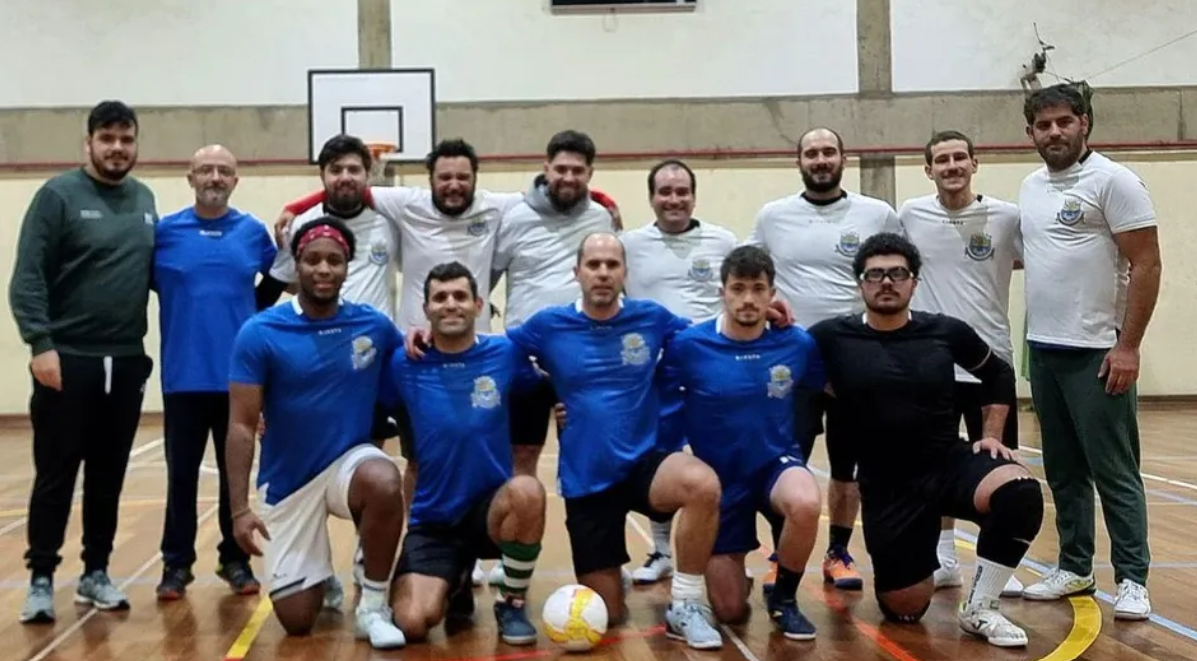
A team from Agueda, composed entirely of deaf athletes, is competing in an amateur futsal championship in Aveiro against hearing opponents. This inspiring experience has provided a different perspective on competition, both on and off the court.
At the entrance to the gymnasium of the Fernando Caldeira Basic School in Águeda, the sound, even if muffled by the partitions, of balls bouncing and shaking against the walls, echoes outside. Training has already begun. After the warm-up, countless ball repositions follow, rehearsed again and again, until the movements are perfectly synchronized. Diogo Teixeira, the coach, taps his foot on the ground whenever he wants to repeat the exercise. Or he raises his hands, and everything returns to the starting point. Communication that breaks the sound barrier. Did I forget to mention? This is a team composed entirely of deaf players, but they compete against hearing opponents. And thus, they break another barrier: that of integration.
From a successful team in the national Deaf Championship, the Águeda Deaf Cultural Association, which has been competing in futsal for 25 years, wanted to become competitive against opponents who did not share its physical limitations. That’s how it discovered the Liga Census, an amateur championship in the Aveiro district, promoted as a recreational and leisure activity and recognized by the Portuguese Football Federation.
We’ve been thinking about this for a while now, admits Diogo Teixeira, with the team captain, David Lourenço, rejoicing that we can finally play against listeners.
Ideas are conveyed in Sign Language with the help of an interpreter. However much one might wish otherwise, communication remains a key issue here. And during the games, things get a little more complicated.
Sometimes the referee calls a foul and we want to understand why, but it’s not easy to do. Often, we just have to accept it, Diogo laments. And there are cases where this difficulty intensifies. In a game against Salreu, a player from our team fell and hurt his leg, but the opponent started saying it was nothing. Our player said he was hurt, but in Sign Language, and the opponent insisted he wasn’t. It was a breakdown in communication, nobody understood each other,” he recounts.
To mitigate these difficulties, referees began signaling fouls by waving their arms or using tissues. “There were even two referees, already quite old, who brought large flags to make it visually easier for us. It was perfect,” points out captain David Lourenco.
This demonstrates that “the League tried to adapt” to the team’s natural needs, praises Diogo Teixeira. Adjustments that began even before the idea became a reality. “When we received the registration request, I questioned the other teams and was completely surprised by the proactivity of all of them. They gave their approval and were willing to help. This is visible when the teams face the deaf team; the interaction is improved to show them that they are part of the championship, praises Armando Tavares, for the organization of the event.
AC Surdos de Agueda has also been doing its part to integrate into the League in the best way possible. We were quite calm, but we felt that the hearing teams have twice the energy and motivation, notes coach Diogo Teixeira, which forced his players to raise their competitive level and “respond with pressure.
“We’re very much about possession, but we try not to touch (our opponents) so much to avoid fouls. Besides that, we need to use many more tactics. We’re growing in that area, adds a coach who maintains a low profile during games, an important quality to avoid distracting his players.
The reason is that deaf people need to be very focused on what they are doing, so any visual information is potentially distracting, leading them to “wait for the break to give the most significant instructions.”
Breaking down prejudice
So many adjustments and precautions create an impact on those who, until now, perhaps hadn’t even imagined them. For Diogo Teixeira, this is natural. He understands that, for hearing people, suddenly receiving a deaf team puts them in a difficult position. In fact, in the first game, they seemed apprehensive about playing with us, they didn’t want to hurt us.” Ultimately, it’s a different reality, with all that this implies.
It’s also true for the players of AC Surdos de Agueda, let’s not forget. The team is made up of athletes between 21 and 50 years old, some from Viseu, Lousa or Coimbra, who meet once a week in Agueda to train. The games are the most visible aspect of the project.
The debut in the Census League was a great challenge for all of us, recalls the coach. There were many reasons for this. It was the start of the game, trying to understand the dynamics of the listening team, also the referee’s, and why we had to communicate. We were quite anxious and apprehensive, but we tried to remain calm, he says.
David Lourenco has personally experienced these differences. Originally from Viseu, he says that the love for football is in his blood, so much so that, in his youth, he risked training with a futsal team that included hearing players. But not everything went as he expected.
When I joined that club, upon realizing I was deaf, they physically showed that they didn’t want me there. Before, when I played informally, I never had that problem, but the communication barrier ended up being very heavy and I started playing with deaf people, he laments.
Today, he works in a clothing store and plays as a universal player for AC Surdos de Águeda. He idolizes Ricardinho and sees the “making of friendships” with other players as one of the main advantages of his experience in the Liga Census.
We taught the Veiros players how to say beer in sign language, and the club posted a story about it on social media. It was funny, he says, smiling.
It’s very important to have a sharing and exchange of experiences. We take the opportunity to explain our language, our culture and identity, adds Diogo Teixeira, who missed a get=together organized by the Juv Futsal Team, from São João da Madeira, because he became a father for the second time. “The feedback was very positive, the players said they enjoyed it. They took the opportunity to get to know each other better, he says.
Despite not yet having won any games in the Census League (with all the significance that entails), AC Surdos de Agueda hopes to repeat the experience in the future. It remains to be seen if the necessary support will be enough, because on the field the team shows clear improvements.
We adapted, we felt more confident, and from the second or third game onwards we started to establish some kind of communication, mainly through mime. In the first game we lost 17-0, it was very confusing for us, but in the last one we played better and it ended 4-0, explains Diogo Teixeira. It’s an evolutionary process, like everything in life. The important thing is that they can experience it.
“Those who see them play find their joy in the games excellent, despite the results. They are a very organized team, they know how to play and have incredible fair play. They are a great asset to the League, praises Armando Tavares, from the organization of the Census League, for whom AC Surdos de Agueda brought a different way of approaching competitions. And how enriching that difference is. Or should be. Unconditionally.