

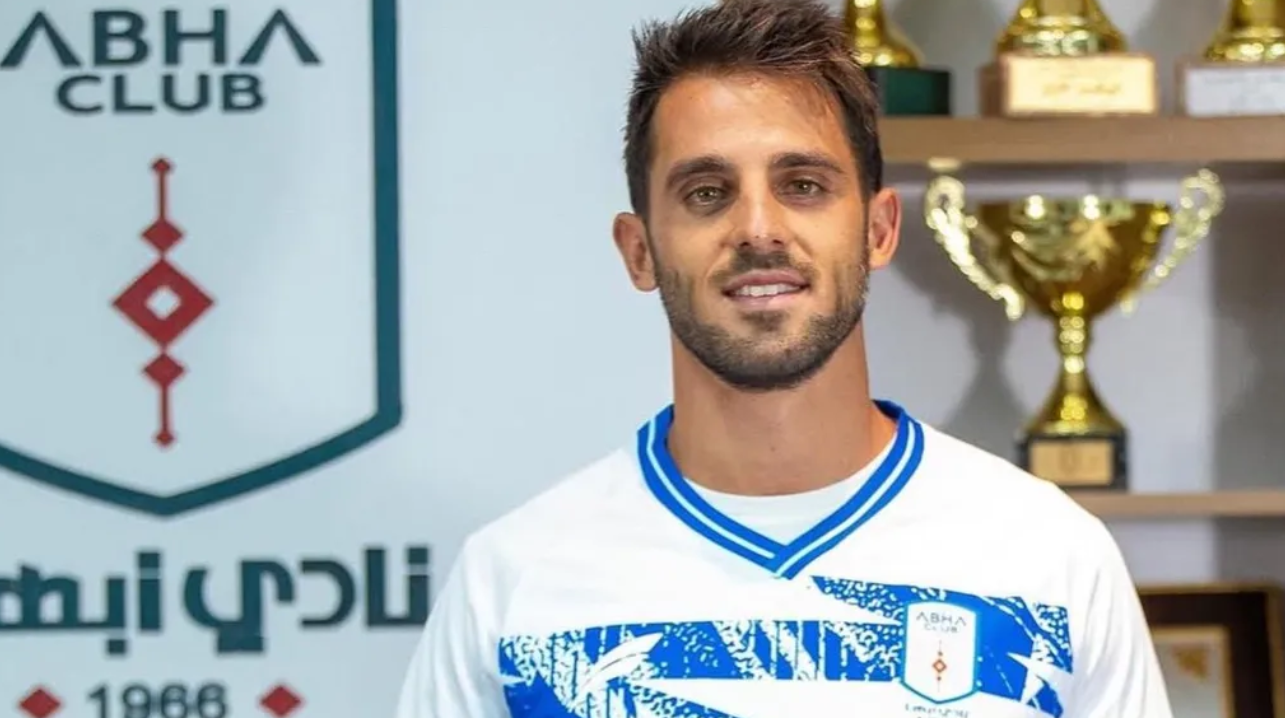
Trained in business management beyond football, Afonso Taira finds space in his sporting calendar for family, economics, and geopolitics. In an interview with Maisfutebol, the midfielder clarifies what he experienced in Saudi Arabia during the escalation of tensions between the US and Iran. Formerly in Sporting’s youth system, Taira won the Saudi second division and has an open future. Especially since politics and football are intertwined = PART I
With two games remaining in his third season in the Saudi Arabian second division, Afonso Taira is eyeing the “leap” to compete with Cristiano Ronaldo, João Félix, and Rúben Neves. At 33 years old, the midfielder, who came through the youth ranks at Estoril and Sporting, led Abha Club to the championship title. Two years ago, with Al Kholood, he celebrated promotion to the top league.
In an interview with Maisfutebol from Abha, in southern Saudi Arabia, Afonso Taira reveals the competitive nuances of that country, discusses the future = even beyond football = and clarifies the geopolitical context arising from the tension between the United States and Iran. For this Portuguese man with an academic background in management, there is room for politics, economics, and culture in a calendar filled with football.
Maisfutebol (MF): Why stay in the second division and move to Abha Club?
Afonso Taira (AT): It was a third step. At Al Kholood we achieved promotion, the adventure in Saudi Arabia couldn’t have started better. At Al Batin it was different, because we missed out on promotion. In this third year, Abha presented me with a more structured project, the choices of players and coach (the Croatian Damir Buric) were well made. The success of this season = champions and always dominant = is the result of a club with a very high level of professionalism.
MF: What is the difference between Abha and the bottom-ranked teams in the first division?
AT: I’m almost certain that, at this moment, if we were playing against them, we would be superior. We’ve already missed key players for key games and the team has functioned without any major setbacks. It’s not luck.
[Interview interrupted by repetitive announcements echoing in the street]
MF: I can’t ignore the ambient sound. Do you want some context?
AT: (Laughs) Of course. Right now it’s 12:20 (10:20 in mainland Portugal) and it’s prayer time. The sound comes from the mosques; it’s the call to prayer. Each village has its own mosque. Around us, within a 500=meter radius, we must have three mosques. There are five prayers a day, and the times vary depending on the position of the sun. That’s why our games have peculiar times, like 2:55 PM or 6:25 PM. Right now, if I were Muslim, we would have to interrupt the interview.
MF: Was it easy to manage the sports season during Ramadan?
AT: It’s never easy. Full adaptation would require turning day into night. I don’t do that because I have my family with me and my children’s school continues at the same times. In other words, it requires creativity to combine meal times, training, and sleep. Many times I would arrive at the locker room after training, and it would already be past midnight.
MF: (…)
AT: It’s difficult to anticipate the dynamics of an internship, because hotels won’t be prepared to serve you at normal breakfast, lunch, and snack times. As an alternative, I bring food from home and eggs to boil in the room. The club provides maximum support, but you have to be cautious.
MF: In the second division is also Jose Peseiro’s Al Ula, fighting for promotion . Only the top two are automatically promoted.
AT: Al Ula (4th) and Al Diriyah (2nd) are clubs outside our area of expertise and of strategic interest to the country, similar to Neom and Al Qadisiyah. Al Ula is in the most developed tourist destination and Al Diriyah is in the historical center of Riyadh. Therefore, they have to get promoted = yes or yes. Furthermore, Al Ula has a good squad, a good coaching staff, and good facilities. Promotion, even if it happens via the playoffs, is very possible.
MF: (…)
AT: In every season I’ve faced clubs of strategic interest, usually champions by a wide margin, with much larger budgets. At that level, they are only behind the top 5 in the first division . This season, Abha managed to dominate on the pitch, which had an impact.
MF: He’s nearing the end of his contract. Is the next step defined?
AT: It’s difficult to decide anything at this stage. When you get promoted, there’s a restructuring of the project and we’re dependent on higher interests. The government and the federation influence various situations, and the club’s management isn’t independent. Of course, I aspire to play at the top, especially since I’ve had two promotions.
MF: Are you already thinking about greeting Cristiano Ronaldo and the other Portuguese players from Al Nassr and Al Hilal?
AT: That would be the icing on the cake. Being able to compete with those stars would be a beautiful step.
MF: But there is a desire to return to Portugal.
AT: It’s inevitable. There’s a desire to compete in the League, a fantastic competition. It’s home. There’s always that desire and the door is always open.
MF: What’s the next step for Saudi Arabian football?
AT: If it’s a project that’s truly different from China and Russia, they have to think about and plan the training system. The Saudi player needs to grow. This is something that already happens in the main clubs. At Neom, for example, all age groups have moved up. There needs to be investment in infrastructure, coaching staff, scouts, nutritionists, and psychologists for training. It’s an important step.
MF: Outside of football, Afonso invested in academic training in management and is interested in geopolitics and sociology. How did you deal with the escalation of the conflict between the United States and Iran, which involves several countries in the Middle East?
AT: All these interests are intrinsic, because I understand that I can contribute more to football than just as a player. Regarding the military conflict, initially it was difficult to predict the scale, but the issue of the Strait of Hormuz, extremely relevant to the industries and economies of several countries, was relatively easy to understand. Saudi Arabia remained stable and calm, taking the necessary precautions – which prevented us from traveling and playing. Abha had no problems whatsoever. It was calmer than it seemed in Portugal.
MF: (…)
AT: For me and my wife, this situation was nothing new. We’ve never been through anything like this before, but I played in Israel, a country where conflict is a daily occurrence.
MF: Beyond the pitch, what sports do you consume? And outside of that context, what do you enjoy doing?